
Our Sites
Donate
Membership
Volunteer

Cotswold Lakes Trust manages a number of sites in the Cotswold Lakes including nature reserves, country parks and car parks. The Trust encourages local people and visitors to access the sites for appropriate recreational purposes.
Country Parks
Neigh Bridge Country Park
This country park is open all year round with plenty of parking and is ideal for accessing the Thames Path National Trail. Neigh Bridge is also a great place to start some beautiful circular walks which will give you an insight into the true landscape of the Cotswold Lakes. Check out the Walking page to download free self-guided walks.
Location: At the western edge of Somerford Keynes village.
Riverside Park, Lechlade
Situated at the head of the navigable Thames, on the edge of the beautiful Cotswold town of Lechlade. Spread out across four large fields, with substantial river frontage, Riverside Park offers loads of green grass for running about, ball games, plus it’s a great spot for picnics and just relaxing. It is also on the route of the Thames Path National Trail, which links to some delightful circular walks. Boat hire, shops, pubs and cafes of Lechlade are a short walk away, just across the 18th century Ha’penny Bridge. There are currently no toilet facilities on site – the nearest ones are within the town so please plan your visit accordingly.
Location: On the opposite side of the river to the town’s marina. From Lechlade, head over the Ha’penny Bridge along the A361.
Nature Reserves
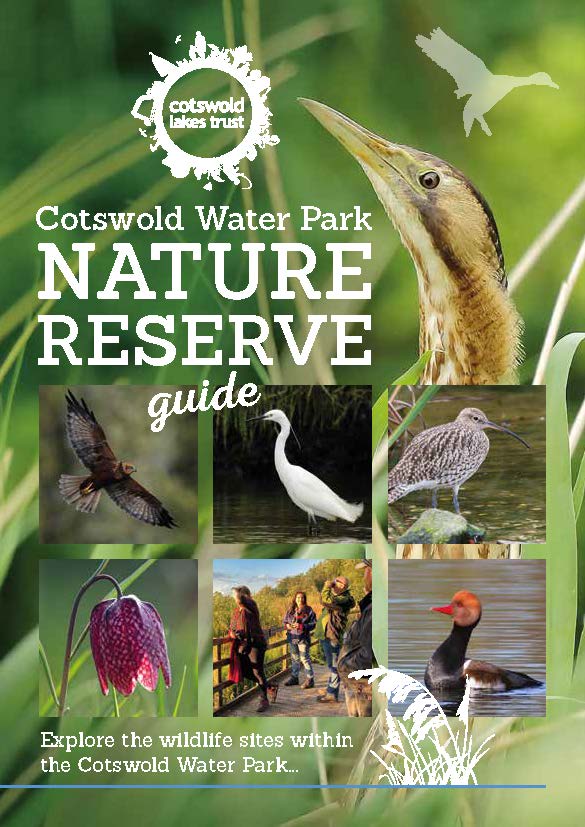
Click to download
Cotswold Lakes Nature Reserve Guide
To find the locations of Cotswold Water Park Nature Reserves and for more detailed information on each, please download the new Cotswold Water Park Nature Reserve Guide.
We would like to thank The Hills Group for their support in producing this guide.
Cleveland Lakes (Lakes 68 and 74)
Cleveland Lakes contains the largest area of reedbed, marsh swamp and willow carr in the Cotswold Lakes, making it an excellent place to view wildlife. The high water quality provides rich nutrients for plants, making it a favourite feeding place for a wide variety of birds and dragonflies. The more elusive Water Vole and Otter also inhabit the streams, reedbeds and ditches at the eastern end of the reserve. Look out for:
Winter and spring: Goldeneye, Lapwing, gulls, and resident waterbirds such as Gadwall, Pochard, Wigeon, Teal and Tufted Duck can be viewed from the hide at Lake 74.
Summer and autumn: dragonflies and damselflies, Blackcap, Sedge Warbler, Reed Bunting, Chiffchaff, Hobby, Sand Martin and Swift. At the heronry, viewed from the Reed Hide at Lake 68, fledgling Grey Heron and Little Egret can be seen leaving the nest and loafing around the site.
Cokes Pit LNR (Lake 34)
Cokes Pit Local Nature Reserve (designated in 2003) is home to a large number of breeding birds including Tufted Duck, Black-headed Gull and Great Crested Grebe. In addition Water Vole and Water Shrew inhabit the site, with vast numbers of dragonflies and a rare aquatic plant, the Lesser Bearded Stonewort.
Springtime sees numerous orchids and other wildflowers blooming in the grass clearings, and several species of bat including Daubenton’s can be seen feeding over the lake at dusk.
Old Railway Line
The disused Midland and South Western Junction Railway now forms a vital corridor of wildlife habitat between South Cerney and Cricklade. Bats, birds and badgers all utilise its lightly wooded embankments for foraging and shelter. The summer nights see parts of the Old Railway Line illuminated by our declining native Glow Worm, whose larvae feed on the snails that are abundant on the railway ballast. Sensitive vegetative management takes place in order to enhance their chances of survival into the future.
A wildlife rubbing plaque trail can be found along the Old Railway Line. See Wildlife Trail for more details.
Shorncote Reedbeds (Lakes 84 and 85)
Here at Shorncote, a 20 hectare reedbed has been established as part of the Cotswold Lakes Biodiversity Action Plan, as these habitats are now quite rare in the UK countryside. These reedbeds provide excellent homes and shelter for a huge variety of wildlife, including Reed Bunting, Reed Warbler, Little Grebe, Snipe, Otter, Water Vole, dragonflies and even the rare Bittern. The islands on Lake 85b have been designed to maximise the area of reed fringe and views across all three lakes are available from the two bird hides on site.

© David Hall
Elmlea Meadow
A Site of Special Scientific Interest (SSSI) and co-managed with Natural England, Elmlea Meadow is designated for its nationally scarce Snake’s Head Fritillary and Downy-fruited Sedge. The wetland meadow is also rich with species such as Saw-wort, Early Marsh-orchid and Adder’s-tongue. The small wetland section of willow scrub is also the only known site in Gloucestershire for Tufted Sedge.

© David Hall
Waterhay Reedbeds
The mineral workings that created Cleveland Lakes utilised an area to the south as a silt lagoon. This lagoon has been colonised by reeds and seasonally wet woodland, and provides excellent habitat for breeding and wintering birds such as Reed Bunting, Reed Warbler, Chiffchaff, Water Rail, Snipe, Teal and Woodcock; as well as “murmurations” of many thousands of Starlings creating their elaborate displays on the way to roost in the reeds. Waterhay is also home to many reptiles and mammals including Harvest Mouse and Slow Worm.
Car Parks

Cotswold Lakes Trust operates several car parks around the Cotswold Lakes, making it easy for the public to access lake views, countryside walks, and picnic sites.
There is a modest charge for parking in these car parks, with the revenue contributing towards the management of our sites and the Trust’s wider charitable work for wildlife and people. Charges start at as little as £1.20, or why not consider joining the Trust as a member and park in any of our car parks for FREE all year round? Join the Trust here
All our car parks are cashless. You can either pay by contactless payment (except Bridge car park) or via a Pay by Phone option. Why not speed up the process by downloading the RingGo app before you visit? No phone signal, or simply stayed longer than you intended? You can pay later (at any time before midnight on the day of your visit) by using the RingGo app or website when you get back home.
*Please note that all our car parks have height restrictors (2.1m) to help prevent fly-tipping.
*Sorry – no swimming, camping, or fires allowed on these sites. Please keep dogs on a lead.
Lakeside Car Park
There are plenty of parking spaces with lovely views across the lake, plus designated disabled parking bays, and picnic places. Many species of waterbirds enjoy loafing on the lake here, but please don’t feed these truly wild birds as human food can decompose in the water and upset the natural chemistry which makes the lake so important.
Location: Along Station Road at the eastern edge of South Cerney Village.
Waterhay Car Park
There’s a reason why this car park is called Waterhay – the area is very susceptible to flooding during the winter months. However, most of the year this makes a very accessible and peaceful car park and picnic spot, with footpaths through to Ashton Keynes, Clayhill Meadow, and a long circular route around Cleveland Lakes, including its bird hides. It is also possible to pick up a section of the Thames Path National Trail from the car park and walk through to North Meadow National Nature Reserve and the delightful Saxon town of Cricklade.
Location: Along the Ashton Keynes to Cricklade Road, next to the bridge across the River Thames.
Clayhill Meadow
A small car park on the Spine Road offers a surprise in the summer months with its delightful wildflower meadow and picnic area. A network of footpaths can be accessed from Clayhill Meadow, both north towards South Cerney and south towards Ashton Keynes or Cleveland Lakes.
Location: Spine Road (B4696) between South Cerney and North End crossroads near Ashton Keynes.
Bridge Car Park
Known locally as the ‘arches’ this 19th century bridge carried the old Spine Road over the railway between Cricklade and Cirencester. Whilst the council-owned bridge is showing significant signs of decay, the car park behind remains in use. This is an excellent location from which to start cycle rides down the old railway track towards Cricklade, or around the lakes to Ashton Keynes. Alternatively you can walk or cycle up towards South Cerney and bearing right follow the old canal path down towards the Gateway. See the Walking page for details of routes and the CWP Walks Guide.
Location: Spine Road (B4696), south of South Cerney next to the Old Railway Line.