Current Projects
Donate
Membership
Volunteer

As a charity, Cotswold Lakes Trust runs several varied and interesting projects, through specific grant funding. These range from the ongoing Cotswold Lakes Water Vole Recovery Project and environmental enhancements on key sites within the Cotswold Lakes through to improvements to public leisure sites that the Trust manages.

Cotswold Lakes Black Poplar Project
With fewer than 8,000 recorded specimens, the native Black Poplar (Populus nigra subsp betulifolia) is the UK’s rarest native hardwood tree. Icon of wetland landscapes and famously featured in John Constable’s ‘Hay Wain’, this distinctive tree fell out of favour following a preference for faster growing hybrid varieties that produced less ‘fluff’ in the spring. The conditions required for sexual regeneration of the species are now fairly niche in the modern UK landscape, with floodplains being drained or developed, and trees cut down where they are viewed as nuisance. And of course once trees are reduced in number, reproduction from seed is clearly going to be more of a problem.
Of the national population it has been estimated that only 500 or so are female trees – an imbalance that also creates a barrier to reproduction, with the result that most planted trees come from cuttings, which of course have DNA identical to the parent tree. Some ‘clones’ are therefore very common and have effectively all come from the same source through history, which makes the species more vulnerable to impacts from disease. So not very good for genetic diversity or a healthy future!
So why is the Cotswold Lakes important for Black Poplars? Well, long-running surveys have identified more than 350 individual trees in the Cotswold Lakes, which would account for almost 5% of the national population. What’s more, over half of the Cotswold Lakes trees are female, which could equate to over a third of all nationally-known female Black Poplars. This is perhaps not surprising when you consider the local landscape – a low lying wet landscape with a network of ditches, streams, and rivers; floodplain meadows, marsh, and wet woodland. A landscape so dominated by other ‘fluff-producing’ willows and poplars that no-one really cares how much is contributed by one particular species. With more wetland being created locally through the ongoing sand and gravel extraction and restoration processes, you would hope that their future here is guaranteed, but the underlying lack of genetic diversity is still a problem.
Since the early 2000s, we have been undertaking a programme of targeted DNA-testing of our Black Poplars, to try and determine which have the most unique DNA, and of course just as importantly, to identify and eliminate from the project any trees that have hybrid genes hidden within. Without this DNA data, any trees that we were to try and propagate could compound the problem and contribute to the Black Poplar’s demise. The key message here is this; if you have any interest in their conservation, please don’t plant Black Poplars if you don’t know their DNA – and trust me, there are plenty on the market. So far, testing has identified a number of different clones, with more than one possibly unique to the Cotswold Lakes, and several that are certainly scarce, mixed in amongst those aforementioned common ones.
Once tested and National DNA Clone Number identified (by Forest Research), cuttings are taken and grown on into healthy trees that can be planted out elsewhere in the Cotswold Lakes and beyond, in an attempt to widen the genetic footprint of the population. This is more challenging than one might think, with useable cuttings difficult to come by, so the demand for new trees usually outstrips demand – something that we’re trying to resolve.
Project FAQs
How do I identify a native Black Poplar? Black Poplars can be quite distinctive with the textbook leaning and deeply fissured trunk, but it’s not always the case. Even when it is, there is no guarantee that you’re not looking at a hybrid, so DNA testing is the only sure way to know.
Where can I buy a Black Poplar to plant on my land? The Trust produces a limited amount of trees from known DNA-tested stock, but we do struggle to meet demand from conservation projects. Anyone is welcome to register an interest by email, and if we have any spare then we will get in touch.
I’ve seen Black Poplar’s for sale elsewhere. Can’t I just buy one of them? You can, but we’d rather you didn’t unless they come from known DNA stock, otherwise there is no guarantee that they won’t contain hybrid DNA. They may also be very common clones that will make the genetic diversity even poorer.
Can I take my own cuttings? If you own the tree then of course you can, but the advice is the same as for planting, i.e. please don’t propagate new trees unless you know the DNA history of the source.
What is Black Poplar wood used for? These days not much, due to its scarcity. Historically it was used for its fire resistant properties, so ammunition cases and flooring around fireplaces were often made with Black Poplar.
Further reading:
Forestry Commission:
Conservation of Black Poplar: insights from a DNA fingerprinting approach
Forest Research Conservation of Black Poplar

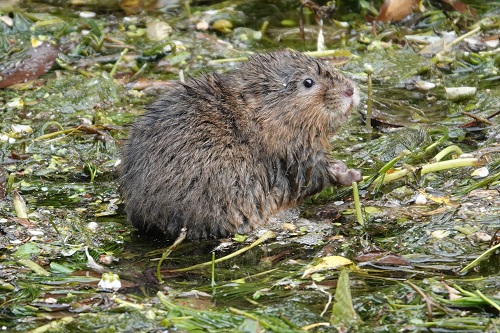
Cotswold Lakes Water Vole Recovery Project
As recently as the 1970s, Water Voles (Arvicola amphibius) were abundant in the UK, with thriving colonies wherever suitable waterside habitat was found. However, this situation then changed dramatically, and by the year 2020 it was estimated that the population had declined by 97%. They are now regarded as vulnerable to extinction (Endangered in England, Critically Endangered in Wales) and are fully protected under the Wildlife and Countryside Act. A catastrophic situation! But why?
The main cause is predation. Water Voles are vegetarians and find themselves on the menu of a variety of native predators; such as Foxes, Herons, Otters, large birds of prey and Pike. Like most prey species, they breed rapidly, which should maintain a natural balance between hunter and hunted – but the appearance of non-native American Mink in the British countryside has disrupted that balance and proved devastating for the Water Voles.
Escapes and releases from fur farms in the 1970s and 1980s soon saw mink thriving along our waterways; their compact size allowing them to easily enter Water Vole burrows, unlike native predators. This easy and abundant food source (along with many other native wildlife species) allowed mink to colonise rapidly and in large numbers, with Water Vole populations suffering huge losses, and extinction in some counties. In the Cotswold Lakes area a few small colonies clung on and, in 2002, the Cotswold Waterpark Society (now Cotswold Lakes Trust) commenced its Water Vole Recovery Project – in an attempt to both protect the survivors and increase their numbers. The project involves three main activities; monitoring and controlling American Mink, surveying the Water Voles and their habitat to monitor the health of the population, and improving wetland habitats to encourage range expansion.
In the early years of the project large numbers of mink were captured and the vole numbers began to recover. In recent years mink numbers have remained low, but it is vital that we continue to keep an eye out for new arrivals to ensure that they cannot rapidly expand in number again.
Monitoring Water Voles and their habitat usually involves a pair of waders and a good long walk, checking for evidence of their activity amongst bankside vegetation along the fringes of the river. The small rivers which run through the Cotswold Lakes support most of our Water Voles; the lakes are more likely to freeze in winter and the gravel banks aren’t ideal for burrowing, with cave-ins likely.
Habitat enhancement largely takes place during the winter months. The voles eat a variety of water side plants and these need sunlight to grow; areas where trees cut out the light over long stretches of river can act as a barrier, preventing the voles from spreading. Where some of the trees are selectively removed or trimmed back, the aquatic and bankside vegetation colonises with surprising speed – followed by the Water Voles.
Project FAQs
How do I recognise a Water Vole? They are much larger than other native British voles, closer to the size of a Rat. Bank Voles and Field Voles are similar in size to mice. Water Voles have much rounder faces, and less prominent ears than Rats.
What signs indicate that Water Voles are present on a waterway? Their droppings, which are about the size and shape of a ‘Tictac’ sweet, are found along the fringes of rivers, often in concentrations at ‘latrine’ sites. We also look for distinctive feeding remains which are frequently left in piles. Burrows in riverbanks might appear to be a good sign, but the presence of another invasive, non-native species, the American Signal Crayfish (which also burrow into our riverbanks) means that the majority of holes aren’t made by Water Voles.
Where can I see Water Voles in the Cotswold Lakes? They tend to be shy and difficult to see, so quietly staking out suitable areas towards dusk provides the best chance. The River Coln, in Fairford, is one of the best places; here a footpath alongside the river has resulted in the voles becoming used to humans and they are seen frequently.
Do American Mink kill other native species? Yes, other small mammals, fish, waterfowl, bird eggs and chicks are amongst their prey.
How well is the Water Vole population faring in the Cotswold Lakes? Much better than in 2002! Numbers are slowly increasing, and they have spread to some parts of most of the streams and rivers which flow through the Cotswold Lakes. This bucks the national trend, so we are very proud of the impact that our Water Vole Recovery Project is making.
How is the Water Vole Recovery Project funded? We’ve been lucky to have had long term funding support from Hills Group through the Landfill Communities Fund, and Lower Mill Estate through their section 106 fund (administered by Cotswold District Council). We’ve also had additional support from local communities and landowners through donations and practical support. You can donate to the project by visiting:
www.cotswoldlakestrust.org/donate