
On the 11th of May 2025, Kim Milsom and Margaret Littler found and photographed a male Red-veined Darter dragonfly at a private site near Ashton Keynes, the first record of this species from Cotswold Lakes. The mature male that they found draws attention by being dazzlingly red over much of its body. Younger males and females are red or yellow and not as distinctive and are best told from other darter dragonflies by looking at their eyes, the bottom part of which is bright sky blue.
This is a southern species which is common from the Mediterranean eastwards into central Asia, but it is on the northern edge of its range and rare in Britain. It is one of several species of dragonfly that are being recorded more and more frequently here, as a result of climate change.
The May date is typical for Red-veined Darter. Like many of our familiar butterflies such as Red Admiral and Painted Lady, and a huge number of hoverflies and other flying insects, adults migrate northwards in spring, bringing them to our shores. They are searching for unoccupied sites where females can lay their eggs, in the case of Red-veined Darter this means warm, shallow, sunny ponds and lakeshores with little vegetation, and this is exactly where Kim and Margaret found it.

Red-veined Darter
Red-veined Darter brings the total number of species seen at Cotswold Lakes to 32, an impressive total for a British site – although it is of course a very big site. The main reason that Cotswold Lakes is so good for dragonflies, apart from the obvious fact that we have lots of water, is that our lakes come in all sizes, shapes and ages, something to suit every fussy dragonfly requirement.
The open, sunny, ponds and lakes that suit Red-veined Darter, and some other species such as Black-tailed Skimmer and Broad-bodied Chaser, are typical of recently worked or recently restored quarries, what can be termed young ponds and lakes.
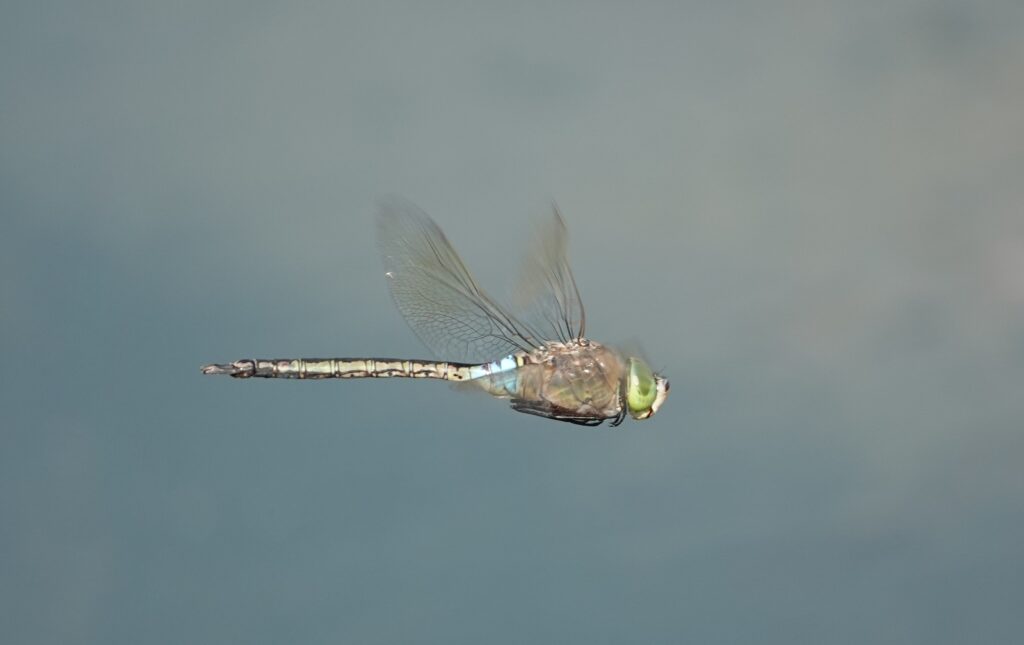
Lesser Emperor
As lakes age, their character changes. Different species such as Emperor Dragonfly, Hairy Dragonfly and Red-eyed Damselflies move in once lakes are a few years old and have developed fringes of reeds and floating pondweeds and water lilies. At Cotswold Lakes these medium-age lakes also host one of our special dragonflies, Lesser Emperor. This is another of the southern species that is expanding its range northwards into Britain as our climate heats up, but unlike the wandering Red-veined Darter, Lesser Emperors, once they arrive, tend to stay put and establish stable breeding populations. It has taken some time at the Cotswold Lakes, there have been sporadic clusters of records dating back to 2005 and 2006, but in the last few years Lesser Emperor has consolidated its population here and become really quite a common sight during June and July. It is probably true to say that Cotswold Lakes is now the best place in Britain to search for this former rarity. Look for a large, fast-moving dragonfly with a bright blue saddle at the base of its dark grey or black abdomen, and green eyes.
Once lakes are a few decades old, and trees have grown right up to the shore and overhanging the water, the number of dragonfly species reduces somewhat but these mature lakes are important for some species, notably Downy Emerald, a beautiful green Dragonfly that is on the wing in spring and seen widely around the Cotswold Lakes.
Smaller ponds suit different species and the thriving underwater community of invertebrates in well-established ponds with a cover of pondweeds and other plants will include the larvae of species such as Southern Hawker, Azure Damselfly and Small Red-eyed Damselfly.
And we must not forget our flowing water; we have numerous streams and small rivers, including the River Thames, flowing through the middle of the area. These support specialist species like Banded and Beautiful Demoiselles, the larvae of the former need silt on the bed of the stream and the latter clean gravel, but they don’t need large areas, and the adults of the two species can often be seen together fluttering over the water.
What will be the next new species we wonder? Perhaps another of the new warm climate species that is colonising Southern England? Southern Migrant Hawker perhaps? Or another nomadic wanderer like Vagrant Emperor? Watch this space… or better still, get out there and find it!
Richard Mundy
Nature Recovery Officer